


I See the Demon cast on mumblegore, trauma, and what it means to be sentient


Jacob Lees Johnson's latest film, I See the Demon, leaves viewers with a lot of questions: not least of which is "what the hell just happened!?" We sat down with cast members Alexis Zollicoffer (Lucy), Noah Kershisnik (Ellis), and Dave Martinez (Billy) to get their perspectives.
Parts of this interview have been edited for clarity.
The Horror Lounge: Well, first of all, I wanted to say I really loved this film. I’m a big horror nerd, and it actually scared me! I also wanted to congratulate you guys on the awards the film won at GRIMMFEST. That's so exciting!
This film is disturbing on a lot of levels. Did you find these characters difficult to inhabit at all?
Noah Kershisnik: I’d say unfortunately, no. [Laughs]. I’m friends with Jacob, the director. Originally, he had cast me to play a smaller role, and he was struggling to find someone to play Ellis. He asked me to do a reading: it was the scene where I first snap and yell at Lucy. He was like “As soon as I saw your audition I was like ‘he’s perfect.’”
I have had a lot of these temper issues where I will yell, and I’ve done a lot of work, personally, to get that under control. I think a lot of times when you’re playing a villain-ish character, it’s easy to be like “Oh, what if I was bad?” Something I try to do is "In what ways am I bad? In what ways am I similar?" And then I can fill in the differences to flesh it out. But I do think that there’s always some part of you that can connect with a character.
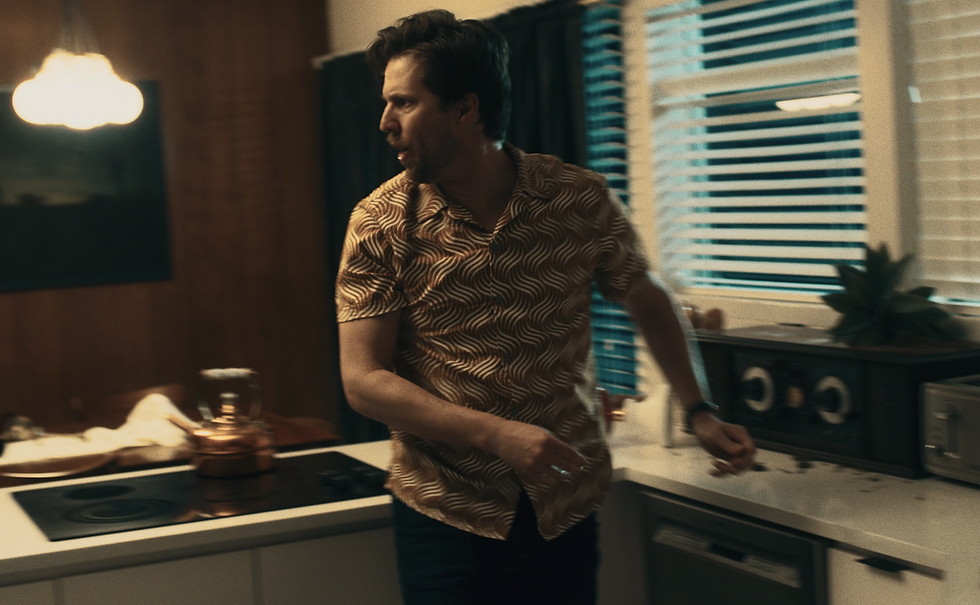
Alexis Zollicoffer: Yeah, unfortunately, at the time, I had a lot of unresolved trauma, and it was very easy to be this very dysregulated person, because at the time I was a very dysregulated person. So, it was really easy to build these false memories into me and just go and act them out in the scenes we were in. Which thankfully (even though, for a year, my life was tough) I was able to process not only the film but my own life and my own history and get to a much better place. But it was unfortunately very easy to tap into what was going on with Lucy.
The Horror Lounge: I’m really glad to hear things are in a better place. Would you say it was cathartic to play these roles? Did you take something from it personally?
Noah Kershisnik: I’d say yes. I like to try and find ways I feel like I do resonate with this character and other ways I don't. Even though I don’t think Ellis’ end is where I want to end by any means. But to inhabit the darkness that you have inside of you and think about that and have even empathy for it on a personal level is, for me, very cathartic: to say "I’m going to tap into my darkness, and I’m going to work through that." Especially in a story structure that sort of punishes the bad and rewards the good to some extent. I think that taking a really good look at darkness and letting it play out as a narrative is – for me – definitely very cathartic
Alexis Zollicoffer: At the time, it was very traumatizing, but now it has become very cathartic. Because at first, after the film, I went “Oh, I should not have done that film.” It was very helpful to read interviews with Florence Pugh when she finished Midsommar and said that she felt the same way, that she left like a piece of her behind in Midsommar and thank god she had Little Women to immediately switch her out of that, because she said she felt super guilty having essentially left a part of her innocence behind in Midsommar. I felt the same way – "Oh, I’ve left something, I’ve ripped a part of myself off and left it in this film." And I will not be able to get that version of me that existed before back. But I was able to rebuild. Now, I will say I’m happy I did the film. But if you would have asked me a month after I did the film, I would have been like “Ah, no, absolutely not.” laughs
The Horror Lounge: That’s a really visceral description. I’m glad you brought up Florence Pugh because I wanted to ask: did you have any inspirations, either roles or specific actors, that you drew on for this film?
Noah Kershisnik: If I did, I’m not thinking of them. I was actually more influenced by people I know and relationships I have personally had with this type of – spoiler – abusive relationship. I think I drew more from my personal experience with abusers.
Alexis Zollicoffer: I got so lucky that Midsommar, Don’t Worry Darling, and Barbarian came out right before we filmed and I was watching those. I watched Barbarian like five, six times. I think I also watched it while we were filming. There was something about the real honest performances of these actresses.
I really wanted to make sure I am being and not portraying. And so I would watch and make sure that as I’m watching them, I’m taking on this energy. Because so many times, especially in comedy but sometimes in drama as well, you can tell that someone is just being a character and they’re not actually being vulnerable. And I wanted to make sure I was existing in a space of vulnerability.
The Horror Lounge: You guys were both just talking about authenticity. I See the Demon identifies as “mumblegore," the horror offshoot of “mumblecore”: very naturalistic, lightly scripted, focused on human relationships. What’s acting in a mumblegore film like?
Alexis Zollicoffer: I will say we didn’t meant to. [Laughs]. It just is what happened. Because I feel like Lucy is not the type of person who wants that attention. She doesn't want people to think her and Ellis are having a bad time. She wants everyone to think that her life is good. She also wants to believe that she's obtained the life that she's always wanted to have, which is safety and security within a loving relationship.
It’s almost like she’s trying to hide what’s happening between them from herself as well. I remember, there was a moment where we’re in the kitchen, and our friends are in the living room, and we’re having this discussion and Lucy just gets so quiet that she’s barely audible. Jacob was like, "I couldn't even hear you."
I would be like “why are you talking like that?!” I would very loudly be like, “actually, get out.” I kick men out of my house. I actually don’t let men into my house anymore. I just, I don’t. laughs.
The Horror Lounge: I love it, I love it.
Alexis Zollicoffer: Nowadays, I call it out. But Lucy wouldn't do that. I do believe that this woman who has been through trauma in her past – she’s almost like whispers “Why are you doing this to us? Can we not just have a normal day?" She makes herself so small because she doesn’t want to admit this is happening. “If I can just sweep this under the rug and make it go away, it's like it didn't happen."
And so that’s kind of where it started but it wasn’t the intention. It was just kind of like what felt most authentic in the moment. It wasn’t a choice, it was just what happened. The more he yelled, the smaller I felt.
And so we also didn’t discuss the improv of it all, but we just did. It felt so natural for someone to say something, and if it elicited a reaction that was off-script, I just felt like it needed to be said. Nowadays I’ve learned to internalize that because – to your question – most directors and writers want you to stay on the script. I’ve gotten lucky where I’ve worked with people like Anna Boden and Ryan Fleck. You’ll be filming a scene and they’ll be like “What if she says this?” And you're in the scene. And you have to pretend you didn't hear that but very naturally deliver what they have just said. And then you get out of the scene and you’ll just start spitballing.
I got really lucky when I was working with Nicholas Cage. He came to me in the middle of a shoot day and said "Tomorrow, we're just gonna improv that scene." And then before we filmed, he was like "Well, what would you say if I said this?" And we improved it before, and he'd be like, "I like that", and we just went in and did that.
So I’ve been lucky that I’ve worked with people who want improvisation. But I think it’s also kind of screwed me over as an actor because I’ve been in callbacks where I will kind of go off script and the director is like “no, the line is this." And in my head, I'm like "I don’t know how to do that – I don’t know how to give you exactly what you’re asking for!" My brain doesn't want to do that. I'll do it, but it doesn't feel as authentic for me. I’m trying to make it feel real for me, but it doesn’t. But that’s okay, I don’t have to work with everyone.

Noah Kershisnik: Jacob wasn't the kind of director who would say "You said the line wrong! It's actually written this way." Jacob’s really free with us and wanting to get a naturalistic performance from the actors - in a way that was almost hard to adjust to for a while.
He’s like “just say whatever you want!” And it's like, "Is this OK?" And he's like, "I just said say whatever you want!"
He’s less aggressive than I just made him sound! He’s not aggressive at all.
It was definitely interesting, especially in those group scenes, to get out of worrying about the sound mix (which did end up being sort of an issue in the end). Jacob really wanted us to just talk. Inhabit the character and say what the character would say. You get sort of used to having this crutch of the script. Like that Ian McKellen thing where he’s like “the words are written down for me!” There were whole sections of this movie where it was like “this is what you’re talking about, go!” It was a challenge, definitely a mindset change.
The Horror Lounge: It’s interesting that we’re talking about this natural, human discussion when we have a really major character who is not human. Dave, can you tell us a little bit about what it was like playing Billy, this character who is understood not to be human.
Dave Martinez: You’re having to sort of strip back your own humanity and analyze why you do what you do, who you are, what you're about, and realizing that a character like Billy contains multitudes, but it’s all out of emulation and simulation, rather than having full-out experiential human interaction. Without giving too much away, it just feels like a bunch of 1s and 0s. It almost feels like the Radiohead album, OK Computer - having moments of uncanny valley and still trying to adjust to being human and being relatable and understanding those emotions. And I think asking questions: when is it just program or when is it something that would count as a human experience?
And so, to work with the cast and crew, it felt like a sort of voyeuristic approach of just watching and being ever-present while still trying to play ball. it's an interesting balance. But to kind of piggyback off what these other two fantastic actors have said, Jacob really sat there with me quite a lot and just discussed how to get the lines. We don’t want it to be too human and not too plastic. And how to do that – that’s a difficult thing. I think some people will say spot on, and other may go, ah, that’s rubbish. It’s all up to interpretation. It felt like an exhilarating ride coming to work because you never really knew what was going to happen.

The Horror Lounge: I think it’s really cool that you mentioned that uncanny valley aspect because I definitely go that when watching the film. I think this is a very topical question, particularly with AI burgeoning as it is, this idea of what is a being and what is a life.
Now, correct me if I’m wrong, but I felt like I picked up on a love triangle between Billy and Ellis. How did you conceptualize that, because I’m assuming you’ve never had to compete for a partner with a robot? Although I don’t know everyone’s lives.
Laughter.
Alexis Zollicoffer: I hope it’s going better for everyone that that! [Laughs].
That was me; I did that. Ah, I wish Mallory was here. I had the thought, okay, this AI robot is raising this little girl. And she is his world and he is her world. But then she’s going to become a teenager. She’s going to reject him as a parental figure and recategorize him as a thing. And I could see Lucy and Chrissy one day going “Is he smooth, like a Ken doll?” and then going to find out. Because they realize he’s not a person, we can literally do whatever.
I can see Lucy, in her rebellious age, being traumatized, having no parents, realizing
"No one wanted to adopt me. Why are you the one that is taking care of me? I hate you!"
Leaving him outside, locking him out of the house, just doing really cruel things to him but then also maybe exploring an intimate side with him because she can. And she’s like, kind of fucked up in the head.
Mallory and I discussed: they’ve definitely kissed Billy. Independently, she was like, "I bet that Chrissy has kissed Billy. Just privately, without Lucy even knowing." And poor Billy has to be like, “I have to recategorize what this relationship is because I’m no longer her guardian. I have been rejected as her guardian, but I'm supposed to be taking care of her." And so it does become – not to speak for them, but I kind of looked at it like well, of course, there’s a weirdness where Billy feels like, "I'm her everything? Who is this man?" And then of course you have Ellis who’s like “you’re no longer needed here.”
Dave Martinez: I remember having some discussions with you, I think it was the first day, Alexis, where there was wondering if there was a romantic element. Jacob was like “Maybe…I don’t know…” I think when it comes down to it there's that layer and level of protection. There’s a lot of moral conundrums on display in this film. We could say that it’s just a horror, psychological, mumblegore film, but it does address a lot of very interesting topics – burgeoning of AI and all sorts of things come into play. How do these morals work, especially with something like protecting - and is there more to that? It's an interesting exploration. I think some audience members will pick up on that, and others may view it just through a protective lens. Or they might say "that was a very strange relationship, very strange film."
Noah Kershisnik: There’s a lot of moral and ethical questions that area raised. When you’re in a relationship with someone, they’ve often have had a father in their life who loves them. That can be a weird sort of relationship, but it can also just be a normal, natural relationship and a natural love. And there's the balancing act of "Oh, I'm now in this person's life." But then, when it comes from a feminist angle, this idea that women need to be protected or that women are an object that was her father's and is now mine as her partner's is a problematic thing as well. In all relationships, with all genders and gender identities, but very strongly in male perspectives, there's a lot of jealousy and possessiveness and objectifying. And it’s interesting because you kind of see Ellis kind of objectifying Billy. It’s like “I have this jealousy. I don’t know what this relationship is. But he’s just an object and I’m going to objectify him. I feel like a king when Billy’s around. I can make him do anything.”
Oh yeah, this is the type of guy who thinks of other things as object. Including, it turns out, Lucy, to some extent. He treats her like a thing to be protected, controlled, contained, maintained - that’s [his] job.
I – Noah Kershisnik – am not a person who believes that AI will become sentient. I remember in Westworld, part of the question is: are those robots living beings? Well let’s apply that to real life. It doesn’t matter if they’re real beings; they seem like real beings. The fact that the humans in that show want a place where they can treat things that are indistinguishable from humans as objects actually says more about the humans than it does about whether or not that robot is sentient or not. And that’s how I feel about these sorts of stories. Whether or not I think that in real life, Billy could be a thinking being, I think what's important is how you treat this thing that is indistinguishable from a real being. And the way that Ellis treats Billy speaks then to the way Ellis treats Lucy, regardless of whether Billy, in reality, could have a soul - or however you want to describe it. I think there’s a big feminist aspect of this. The way that Ellis thinks about relationships with women, and with people, and with objects - he probably has some really deep jealousy there. He's decided "I'm the human. I get to do whatever I want." And that actually is an inhumane stance.
The Horror Lounge: I could look at this title in a lot of ways. For each of the three of you, who is “the demon” in the title?
Noah Kershisnik: I think every character in this has their own demon. And I think the demon that you’re gonna see when you watch it is your own demon.
Dave Martinez: There's an old Company of Thieves song that borrows from an Oscar Wilde quote and says “We are all our own devil and we make this our place our hell." A lot of times, you're not integrating the understanding of who you are, that you are capable of great good and great evil, and the understanding that those two things are always constant. But the moral thing is to say: "I am capable of doing wrong. I am capable of doing great harm. But I am going to choose to do good. I'm going to be kind." I think that demon is often misunderstood. It sometimes can be pure evil. But there's also the demon of assumption. The demon of choosing on somebody’s behalf to do something that they would not want to do. We live in a world of demons, but it’s not all just the horns. A lot of times, it’s indecisive nature and poor awareness and unconscious behavior. If we were able to rise above that we would see something a lot more beautiful, where you have people that are living in a more conscious way.
And I think this film – I don’t think I can hit on it enough – the moral ambiguity of some of these scenarios and that [AI] is on the rise, when we like it or not. We use a lot of these programs: "I need you to schedule these meetings for me; I need you to create a website for me." When does it cross the line, when a decision is made that you did not OK, but it assumed that you would? Now we are in trouble.
And so, y’know, we create demons, we have demons, you look in the mirror and you can see what you want. And hopefully we can see something beautiful. That would be my personal choice. There’s always light. But being aware is the first step to that acknowledgement and to true growth. That’s all I have to say all about that!
Alexis Zollicoffer: I think it’s trauma, either the trauma you’ve experienced or the trauma you’re experiencing. The audience, when they're watching the film, has the opportunity to make that decision for themselves.
I See the Demon is now streaming from Archstone Entertainment.


Comments