


Interview: Director Harry Locke IV on his horror debut Kaishaku

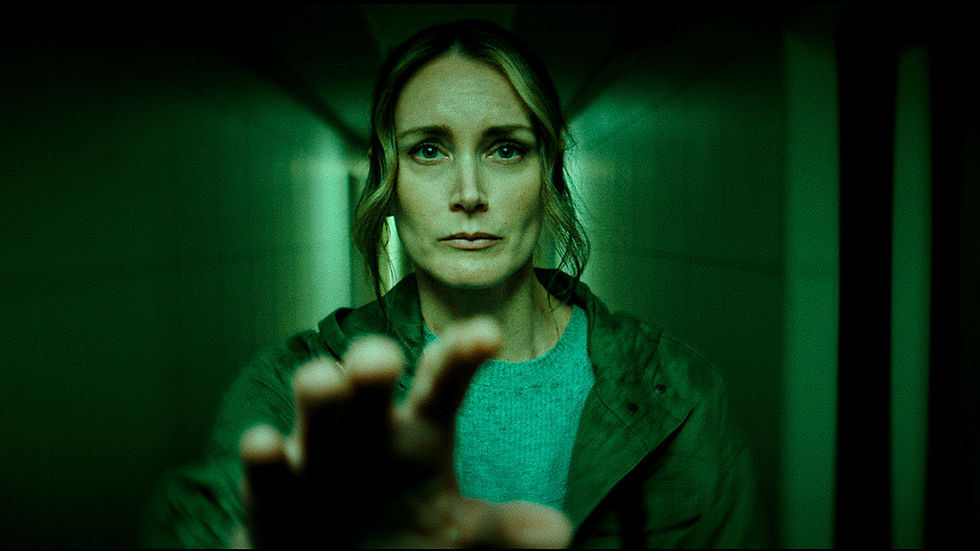
While Kaishaku is an indie horror movie with supernatural elements, it also grounds itself in a real Japanese suicide assistance ritual, and a family’s class struggles. The movie handles its ethical quandary quite well, while giving us well-drawn characters, especially the protagonist, Iris, played by Stefanie Estes.
Iris needs to decide if she should be a “spotter” for her childhood friend, Bridgette (Alyshia Ochse). Of course, Iris doesn’t want her friend to kill herself. However, if she agrees to be a spotter, it could save her family from financial ruin, especially after her husband loses his job.
We spoke with the film’s writer/director, Harry Locke IV, about his inspiration for the film and how it combines supernatural elements with a family’s tangible struggles just to survive.
This interview was edited slightly for clarity.
The Horror Lounge: How did you hear about the Japanese ritual of Kaishaku, and what made you want to use this concept in the film?
Harry Locke IV: That was a really interesting last minute development that popped up before we shot the film. Originally, it was called The Spot. That was the title when I first got the script. We ended up changing the title from The Spot to The Spotter and lived in that world for a while.
Robbie Allen, who plays Jackson in the film and is one of the producers, we went back and forth with a bunch of different things in terms of aesthetic and design. I called him up with last minute ideas I had. He’s a very patient guy and listened to all of these crazy ideas I had. Originally, with that climax scene when Bridgette’s husband [Rob Kirkland] confronts Iris about the money, he originally confronted her with a gun in the deli. I didn’t know why, but I saw him there with a sword. I didn’t know why he had a sword or where he got it from, but Robbie, who is a big historical buff, said in Japanese culture with Seppuku, there was an assistant, to ensure the person didn’t have an agony and would follow through with it. They would behead a person with a katana.

He told me this maybe a week or two before filming. I said, that’s the movie. I always love trying to root a little historical, real life facet to these fictional stories. I called Mike [Gerbino], the writer, and told him about it. He didn’t know about it either. He also found it fascinating. I said let’s try to find other ways to weave that aesthetic into the film. Just that little simple idea allowed the film to take on a whole different life.
The Horror Lounge: Can you talk about the characters in this film, especially Iris? I was impressed by the way she’s written, specifically how she does what she has to do to keep her family afloat.
Harry Locke IV: That’s a great question. I wanted to find a piece that allowed me to dive deep with Stefanie Estes, who I think is a terrific actress. We worked together on a western that I wrote and directed. It was a short that we did back in 2018. It premiered in 2019. There was a feature version we tried to get developed. For various reasons, it didn’t pan out.
I was looking for a project where we could reunite and do a feature, not a short. When we looked for a project to get going in 2023, horror was not on the top of my pile. I’ve only recently started really liking horror films. I wasn’t a horror guy, except for the mainstream classic ones. When I read Mike’s script, what really gravitated towards me wasn’t just the thrills and chills part. It was this emotional weight and moral ethics that surrounded this character.
I feel like Iris is a person of the zeitgeist. We’re either going through or close to people going through financial issues. Times are not getting any easier, and there’s a lot of uncertainty. We’re feeling a lot of that weight, not only how that affects us, but how it affects our family members and our responsibilities to others. When I read the script, I fell in love with how heavy the story felt.
I know that with working with Stef, she would understand that we had to ground the characters in a layer of realism. That first act really needed to set up Iris. Is she a person who jumps at the first, easiest thing? Or is she the kind of person who will say my back is against the wall and I’m really worried about the future of my family? She’s a mom at the end of the day. She’s really the core of allowing the characters to exist in a realistic space.

The Horror Lounge: Was it challenging to film some of the more heart-wrenching scenes, like the moment when Iris has to ration pills because she can no longer afford refills, or Bridgette’s botched suicide?
Harry Locke IV: On the first day, when we had the crew lined up, I made it clear there would be some difficult shooting days. There were people involved in the project, myself included, who have lost friends or family members to suicide. I said that at the end of the day, my primary concern is the wellbeing of the cast and crew. I told them if they felt like things were too much, they could excuse themselves to make sure they’re okay.
I just wanted to make sure that with anything we were doing, we were paying it proper respect. I feel like there’s an easy way to make a bad version of this film. You could glorify the suicide thing or lean into the goriness of it. I really tried not to glorify that. I didn’t want to use it for shock value. It’s this very muted and grounded journey into this woman wanting to end her life. Even coming into that process, I came through a string of personal things. I lost my mom a year and a half before the project. I was going through a divorce. I carried a lot weight into the project, and in a way, it was cathartic to develop that story with these characters.
I told my cinematographer it’s a horror movie, but I wanted to find pockets of visual beauty, so when we do get some of the more visceral, aggressive things, it’s a nice juxtaposition. I think we were probably most successful with that suicide moment with the cardinal on the tree. You know it’s coming, but it comes in a way you don’t necessarily expect it to play out. I’m really happy we were able to achieve that in the film.
The Horror Lounge: This was your first experience directing horror. Would you be more open to directing horror now?
Harry Locke IV: What’s so interesting about the horror genre now is that it really has become this playground for filmmakers to blend all sorts of genres. You can really dig into different styles, different narrative devices, and come up with some really unique ways of telling stories. I love it for that. We even got to a point where I wondered if this was horror or a psychological thriller. The movie lands in different ways for different people. Some people honed in on the mood and atmosphere, though were not necessarily scared. They were with the characters and felt that heaviness. When we did some test screenings in LA, we also had some people that jumped at stuff that popped up on the screen, when the teeth come out.
It’s opened my eyes. I’m not opposed to doing another film in that genre. I just want to continue making good films. If that next film happens to be horror, and the script is great, I’m down to do it. I just want to keep telling the best stories possible. What’s really cool is that you can be really intuitive in how you get these films made. I think we did a great job with Kaishaku where you don’t feel its financial limitations. It’s a polished film, but it’s a small team that put that film together.
There’s still some stigmatism with indie horror. When we tried to get an actress to play Bridgette, I originally tried to get Angela Sarafyan. She was just in Superman as his Kryptonian mom. I remember we wrote to her reps and said it’s a low budget indie horror movie that we’re shooting in Kentucky. They didn’t really give it a chance to see it’s more than a standard horror film, but I get the stigma that goes with it. I’m not necessarily a household filmmaker, so it’s a risk for a talent like that. I do feel there’s still that stigma we’re trying to get over, but there’s a lot of great filmmakers in this space.
When I was at Dancing with Films, I saw a lot of great Midnight films working in that space. It’s cool to be part of that right now.

The Horror Lounge: What’s next for the film?
Harry Locke IV: We have a couple more festivals that we’ve submitted to. We have yet to do our international festival run. We’re waiting to hear back. We have been talking to distributors. We have gotten offers. I’ve been talking to my main producer. We are exploring the idea of potentially doing self-distribution domestically.
We all would do this for free if we could, but rent is due every month. Mortgages are due every month. It’s nice to try to get as much as we can for all the work that people put in. We are exploring potentially self-distribution domestically and maybe a distributor for international. We are exploring distribution. I am confident that the movie will get picked up and it’ll be out there. Later this year would be great, but we’re not in a rush. We’re really enjoying the festival circuit.
My first feature got absolutely shredded by reviewers. They said don’t ever let this guy by a camera again [Laughs]. It’s been really pleasant to read and hear the responses from people gravitating to this film and to the performances. As a director, you’re really a curator of that aspect. I just wanted to make sure the cast was protected and their best foot forward was put on screen. If anything, at the end of the day, that feels like the biggest win for me and the film.
More festivals and distribution soon.
The Horror Lounge: Is there anything else you’d like to add that we didn’t cover?
Harry Locke IV: We discovered the script via InkTip, the online script aggregator. We were in a very interesting scenario where we had the finances to make a movie, but not the script. There was a script I had written that we were developing. It was a large-scale project, but it fell apart during COVID.
We worked with InkTip, and they got us 450 script submissions. I went through all of the submissions. I got it down to 30 and then down to Mike’s script. It was a great 89-page read that I read on a Sunday. I thought the concept was great. Mike was a great guy to work with. He was down for the changes and additions that we put in there. Even while shooting in Kentucky, it was a great process. I think most people have walked away from this film feeling very positive about the experience. To have it well-received is icing on the cake.


Comments