


Mother of Flies is a witchy journey with deeply personal stakes


The Adams family is a well-known unit within the broader filmmaking and horror communities. Mother Toby Poser, father John Adams, and daughters Zelda and Lulu Adams take a DIY approach to their craft. They direct, edit, star in, score, and probably even cater their own films. This has made the family darlings on the film festival circuit, but at this point, they should be considered some of the best genre filmmakers in the game. Their latest feature, Mother of Flies, is a deeply personal story about illness, survival, and witchcraft. It has mesmerizing visuals and a heart wrenching narrative at its core.
Zelda Adams stars as Mickey, a college student who stares down her own mortality due to a cancerous tumor in her stomach. Traditional medicine, such as chemo, has failed, so she enlists the help of a "healer" named Solveig (Poser). Mickey's dad, Jake (John Adams), is of course skeptical. Eventually, however, he gives in with a sliver of hope that maybe, just maybe, this will reverse his daughter's diagnosis. Why not try some non-traditional medicine?
From the outset, there's something mysterious about Solveig. She lives deep in the woods, occupying a house that looks like it grew right out of the Earth. Moss covers the beds. Trees poke and protrude out of every corner in every room. This causes Jake to wonder if he should just grab Mickey, get in the car, and turn around. He struggles with the concepts of faith, ritual, and the supernatural. Ultimately, and at Mickey's urging, he decides to see it through. Solveig, meanwhile, senses that there's something wrong with Jake. He doesn't have a physical illness, but he certainly harbors a lot of sorrow and worry regarding his daughter. He, too, needs healing.
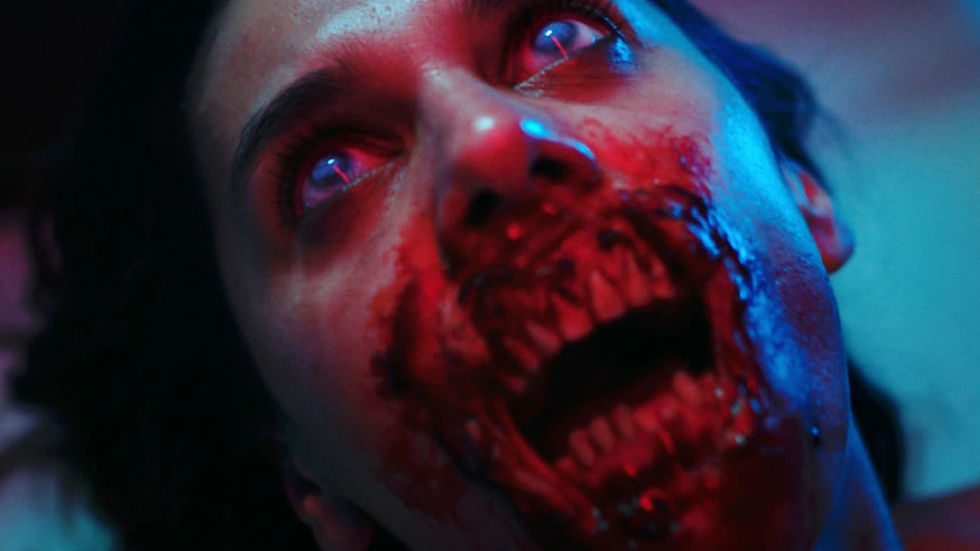
Yet, as the movie progresses, it's evident Solveig might not have the best intentions regarding Mickey. By the film's conclusion, Solveig is given quite a detailed backstory and history, which explains why she's interested so much in Mickey. However, to avoid spoilers, this review won't dig into her backstory. That said, Solveig's true intentions create some harrowing and grisly circumstances for Mickey, as well as some bloody imagery, including fetuses, that leaves quite the imprint. Even a pile of rocks transforms into an eerie and foreboding visual.
Regarding the performances, Zelda Adams is one of the high points. On the one hand, she conveys her character's optimism that an alternative "healer" may be able to cure her, while at the same time, expressing private worry about the fate of her own mortality. Poser is an imposing presence on screen, portraying a witch who's anything but a green-skinned caricature. The film really benefits from Solveig's layered backstory and Poser's performance as a complicated and complex villain. John Adams keeps Jake's performance grounded in a father's justified worry over what may happen to his daughter and if this alternative medicine is the way to go. Jake struggles opening his mind to the occultism unfolding before his eyes.
Most Adams family films, be it Hellbender or Hell Hole, emphasize nature. That's very true here. The woods are not just Solveig's home. The forest is a living and breathing character. Poser delivers several poetic lines about the cycle of life, how everything lives and dies and there's beauty in that process, including death. Overall, the movie is packed with arresting visuals of the natural world, including a few shots of buzzing flies and writhing maggots.
Mother of Flies continues some of the themes that the Adams family explored in their previous work, especially connection to nature and also witchcraft. That said, this feels like their most personal film to date. It's a movie about survival and mortality, shot with the same DIY ethos that makes the Adams family some of the most interesting genre filmmakers today.
Mother of Flies will stream on Shudder beginning January 23.


Comments