


31 Days of Horror: Exploring Mystery in Theology of Horror: The Hidden Depths of Popular Films
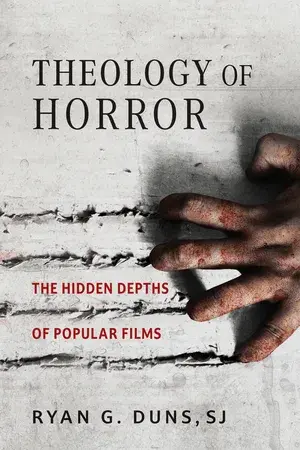
Religion is no stranger to horror films. Popular horror movies including The Exorcist, The Omen, and Rosemary’s Baby all have religious themes and symbols. But most of us would not think to examine such films such as The Purge or The Black Phone through a religious lens (unless of course, we are examining the boundaries of what is wrong or right). In his book, Theology of Horror: The Hidden Depths of Popular Films (Notre Dame Press, Paperback edition, 2026) author Ryan G. Duns, SJ, contends that horror films offer a way to explore theology which is defined in his introduction as “the art of faithfully discerning and responding to the ways that God has revealed the define self in history.” Taking a closer look at 15 horror films, Duns seeks to convince readers that such movies are ideal places to explore various philosophical and theology ideas.
Duns divides his book into three sections: Monstrous Being, Infernal Icons, and Dark Graces. In these sections, Duns explores a variety of films. Certainly, familiar films that have religious symbols and figures are included. Yet Duns chooses not to dwell on the obvious religious symbolism. For example, in the section Monstrous Being, Duns looks at the film The Exorcism of Emily Rose by explaining that the movie is about two ways that reality can be interpreted. According to Duns, the movie asks two important questions: Is reality distant from the supernatural or do we consider that there are ways that the supernatural and the natural coincide? The answer, of course, is not so simple and one that he grapples with in his book.
Another example is Rosemary’s Baby. Most people know the basic plot of this film, but once again, Duns does not dwell on the obvious religious characters and symbols. Instead, he looks at this film through the lens of Noel Carroll’s complex discovery plot theories. Acknowledging that in some ways he is oversimplifying Carroll’s thoughts, he nevertheless gives a brief overall explaining that the onset, discovery, confirmation and confrontation of the dark transcendent actually mirror the logic of many New Testament stories.
Many other movies are examined. For instance, in his analysis of The Texas Chain Massacre he contends that “Feeling horror may not be good for the soul, but it is sign of soul.” In another film, The Conjuring, he spends time talking about the ways that evil can manifest in our lives. And in yet, another film, Hellraiser, he discusses the differences between
superstitions and theological sacraments.
Readers who venture into this book should prepare themselves for some heavy reading. Yes, Duns' prose is lively, filled with personal stories related to his experience as a professor in the college classroom. But he also brings in a variety of research including film theories and religious texts. Gothic novels and short stories are also discussed. Sometimes his connections between these texts and his film analysis are clear, but at other times, I found myself re-reading his theories about his films to come to a clearer understanding.
Ultimately however, I think that Duns succeeds in his overall goal. In spite of his background, he is not trying to “convert” anyone. Instead, in his introduction, he states that horror films are often considered the domain of the atheist. His book, of course, suggests otherwise as he pushes readers to think about horror films through the lens of mystery and faith.


Comments