


Still Floating: 40 Years of Pennywise Celebrates Stephen King’s IT
I first read Stephen King’s book IT when I was in eighth grade, and I remember three things about this experience. First, I was proud of myself for finishing this behemoth of a work. (Certainly, it was the longest book I had ever read at that point in my life). Second, I loved the characters in the book – they were part of the “Losers Club” and perhaps I recognized as least a little of myself in them. Finally, the book scared me. No, it wasn’t the image of the clown that gave me nightmares. Instead, even at a young age, I recognized how scary it was that a small town could keep its most awful secrets. Indeed, perhaps I recognized the setting because it reminded me of the small rural Pennsylvanian town where I grew up.
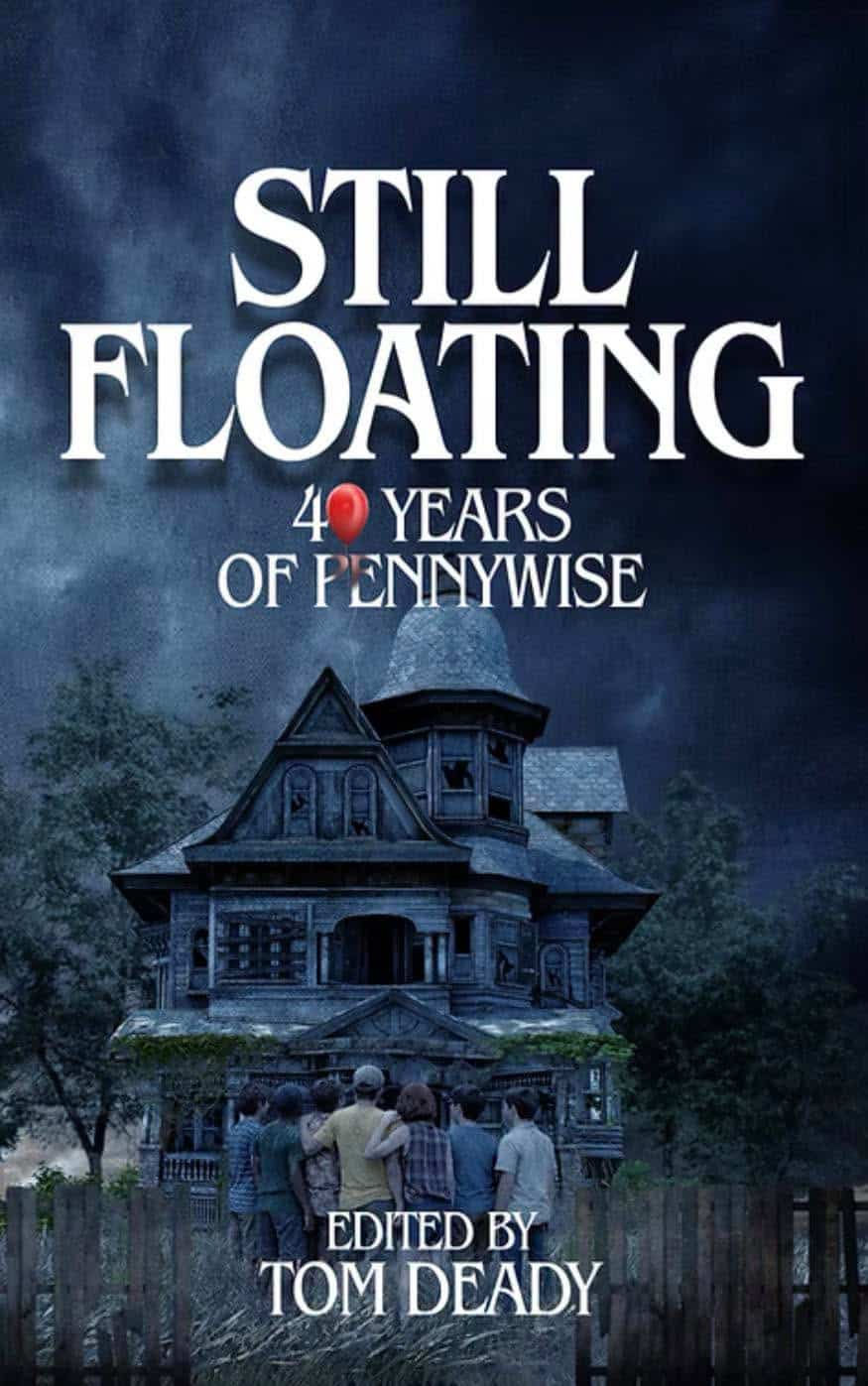
Since its publication date in 1986, IT has become one of King’s most popular novels. In Tom Deady’s, Still Floating: 40 Years of Pennywise (Greymore Publishing), 34 essays and Interviews examine IT’s popularity. Some of the essays are reflections about the characters and the setting, while other essays offer more of a close analysis of the themes found within this book. Sometimes, the essays touch on the films (both the 1990 miniseries and the 2017/2019 films). Sometimes, the essays look at real events and places that inspired certain aspects of the book. Together, all of these works offer a thorough understanding of one of King’s most popular novels.
Deady organizes the essays and interviews into five sections and the first section, titled “Welcome to Derry” is, of course, dedicated to the setting of Derry, Maine. In “Strolling through Derry,” author Glenn Chadbourne takes the reader through Derry (aka Bangor, Maine). He notes that the book describes much of Maine during this time period explaining, “There was a lot of roadside trash. A lot of booze addled abuse. Things were run down, the town, the roads, you name it.” Chadbourne goes on to explain that in situations set in places like this, kids either give up and imitate the adults or rise up and fight back. In IT, the cast of child characters fight back. In another essay, Tamika Thompson looks at the role of racism in “The Black Spot: Hanlon and Hallorann in Stephen King’s IT” by connecting Will Hanlon (the father of Mike, one of the child characters in the story) to Dick Hallorann, who appears in King’s novel, The Shining and is part of Hanlon's memories in IT. Indeed, Thompson contends that Hallorann serves as “a bridge between a racist town and the supernatural powers” that Mike will eventually face in IT.
For me, one of the most chilling essays in this entire anthology is the one that explores the real-life case of Charlie Howard, a young gay man who was murdered. In his essay, “Ghosts of the Kenduskeag Stream: The Gay Bashing of Adrian Mellon and the Restless Shade of Charlie Howard,” Michael Rowe not only recounts the life and death of Charlie Howard, but they also look at the chapter dedicated to Adrian Mellon, a character who is modeled after the real Howard. Mellon’s character is not part of the IT television series, but his death opens the movie, IT: Chapter Two. Rowe points out the importance of incorporating a gay character in a novel published in the 1980s during the AIDS epidemic, concluding that “I had no sense that the writing itself was in and itself homophobic, and would have been startled if anyone suggested that it was.” In Rowe’s critique, the writing was painfully realistic.
Derry is the setting of this novel, but Pennyworth, in all his clown glory, is the villain (and indeed some may believe he is the main character). Thus, there is a section dedicated to Clowns, Coulrophobia (fear of clowns) and Monsters that frighten us. In “I(t) Pagliacci: An Incomplete History of Clowns as Darkness Discussed as Light” Bracken MacCleod frames the role of Pennywise in the history of clowns. Other essays shift the focus away from clowns as physical evil and look at the symbolism of monsters in general. “The Werewolf’s Face is Our Face: At 29 Neibolt Street with the Losers in Stephen King’s IT” looks at the influences of other works in IT including Lewis Carroll, H.P. Lovecraft, and Shirley Jackson. And Hans-Ake Ulga in “What is a Monster?” explores what truly defines a monster by comparing IT to John Ajvide Linquist’s novel, Let the Right One In. Finally, Rebecca Cuthbert reminds us of the outbreak of clown sightings and red balloons in her essay, “99 Red Balloons Get Tied: 2017 Sewer Drain Installments as Cry for Connection.” While many believed that the red balloons tied to sewer grates in American were some kind of prank or clever advertising for the film IT that was hitting the theaters during this time period, Cuthbert suggests that instead, those (most likely, teenagers) were creating a sense of community: “Leaving those messages was an opportunity to stand what they cared for – waving a balloon instead of a flag.”
As with all anthologies, readers will find essays that most resonate with them. For me, I enjoyed the pieces that examined the roles of the Losers Club the most. In “Childhood Magic” Char Cocrane surveys the roles that each of the child characters play, exploring why so many readers related to the members of the Losers Club. In “IT and Stranger Things: A Shadow cast by Love” Jonathan Janz looks at the similarities between the child characters in both King’s novel, and the popular television show, Stranger Things. Finally, author Paul Michael Kane in “The Enduring Power of Friendship in It” offers a close analysis about what the novel really says about friendship. To Kane, friendship can offer sanctuary in an unfriendly world and IT also offers the “power of unity” against all kinds of fears. Still, according to Kane, while the novel celebrates the power of child friendships, it also looks at the fragility of adult friendships.
In essence, Deady’s anthology is a must read. While many of the authors include personal reflections and stories about IT, others dive into a deeper analysis of the characters, settings, and themes of the book. If you are a fan of IT, you will want to read this anthology. At the very least, this book offers a trip down memory lane to your first read of the novel or when you watched either the television miniseries or the motion pictures. Still, more importantly, many authors offer a deep analysis of the themes that may help you rethink critical aspects of the book (or the movies) that are often lost.


Comments