


A Harbinger of the past: A spoiler-free review of the latest Shogun Films horror
“Hammer Horror” has been a name to conjure by amongst horror fans since screens were first rendered silver, much to lycanthropic chagrin. Famed for producing some of the greatest horror hits of the 1950s, Hammer films had its start with smaller productions filmed in country homes to save money, which along with its technical details, gave it a distinct style. With such talent as Christopher Lee, Peter Cushing, and Jacqueline Pierce, Hammer defined the early horror film genre, and countless film studios strive to follow in the shadow of its specter. Shogun Films, a new and growing production company based in the UK, is one of these. With a focus on “high quality, low budget traditional genre movies” Shogun, a “disruptive independent production company” leaned into the Hammer style with its latest horror film, Harbinger, directed by James Crow. And while there are a few minor snags that break the Hammer feeling, Harbinger hits the nail on the head, with a veteran cast of believable characters, reliable practical effects which don’t come from a computer, and a solid story which leaves viewers both satisfied and curious about a second helping.

Harbinger hits the Hammer vibe nearly perfectly, and even those not as immersed in the richly murky history of Hammer Horror will find the vibe cozily creepy. Harbinger tells the story of Julia (Jeanine Nerissa Sothcott), a woman tormented by her near death at the hands of Henry Decker (Peter Woodward), her own lover and a sadistically satanic serial killer. Brought back to the site of her narrow escape by a paranormal investigation TV crew, Julia finds that the horrors haven’t ended with Decker’s demise. A mysterious fortune-telling machine, the titular “Harbinger,” predicts a gruesome demise for all involved, as Decker’s sinister soul seeks to return from death. It’s not anything too new to horror fans, but the plot is a classic for a reason, and it wouldn’t have been too out of place in the days of Dracula, The Mummy, or The Wicker Man. But some parts of Harbinger don’t quite match the vibe of even the 1971 Hammer Film, Lust for a Vampire.
With the premise as a basic recipe for a Hammer hit, Harbinger follows the Hammer handbook almost perfectly. The film’s primary setting, a large, isolated house, especially had an eerie atmosphere, with actual ghosts as extras, according to lead actress Jeanine Nerissa Sothcott in an interview with The Horror Lounge. The tone and ambience are creepy and concerning, and the practical effects being non-digital, viewers will as if they’re back in the heyday of horror, at least until the kills come up. While many of the kills are solid, several of them are particularly brutal, which at times pulled me from the atmosphere. It isn’t the case every time someone dies horribly, but frequently enough the author found himself saying “They couldn’t show that in a Hammer Horror film.” Others strangely seem a little under-done, leading to an unusual juxtaposition. The kills aside, Harbinger follows the Hammer formula well, especially where the cast is concerned.
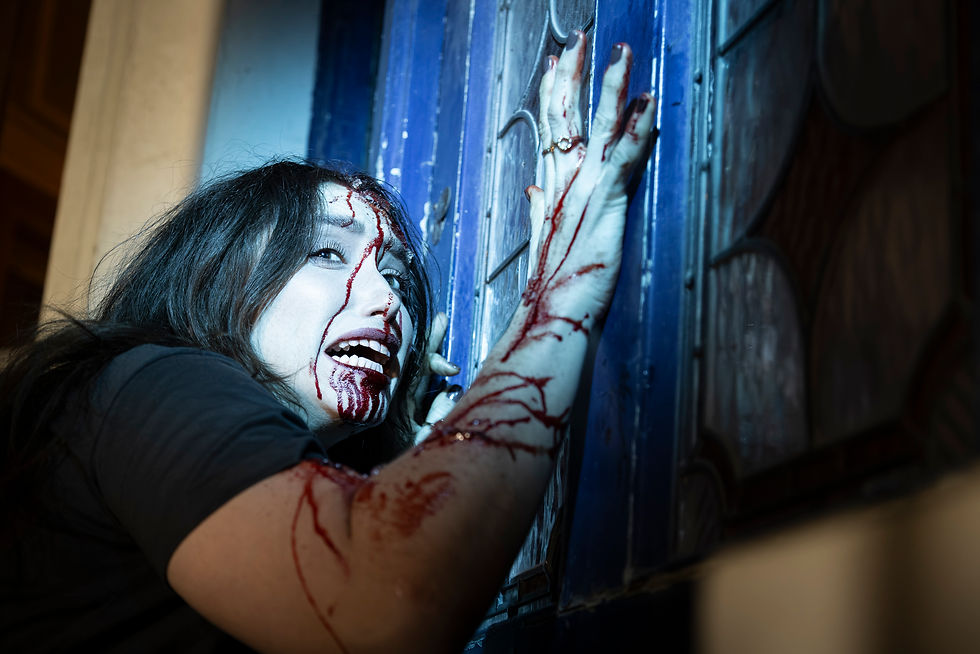
As could be expected with a cast of experienced actors, the acting in Harbinger is strong, but it’s at its strongest when the majority of the cast are able to play off each other. Leading the film are Jeanine Sothcott and Gary Webster, respectively playing Julia, the sole survivor of Decker's rampage, and Mike Craggs, the host of the paranormal investigative team who bring Julia back to the house of the Harbinger. Both have a strong list of roles, both horror and non-horror and both on the silver screen and on the stage, and they bring those skills fully to bear. Alongside Sothcott and Webster are a strong supporting cast with a few extraordinary connections. Peter Woodward, who plays the devilish Decker, is the son of the late Edward Woodward, who starred in The Equalizer and, ironically enough, The Wicker Man (1971), which pops up in our Interview with Sothcott and Webster.
Woodward brings the madness with every gesture and sentence, making Decker one of the most memorable characters in the film. Adding a further nuance to the cast list is Carol Ann Ford, who while best known for her role as Susan in the original Doctor Who series has her own share of horror credits. Ford plays Julia’s mother, a major influence on the character. Much like the Hammer days of yore, these connections add a strong spice to the film, on top of it's already savory acting.
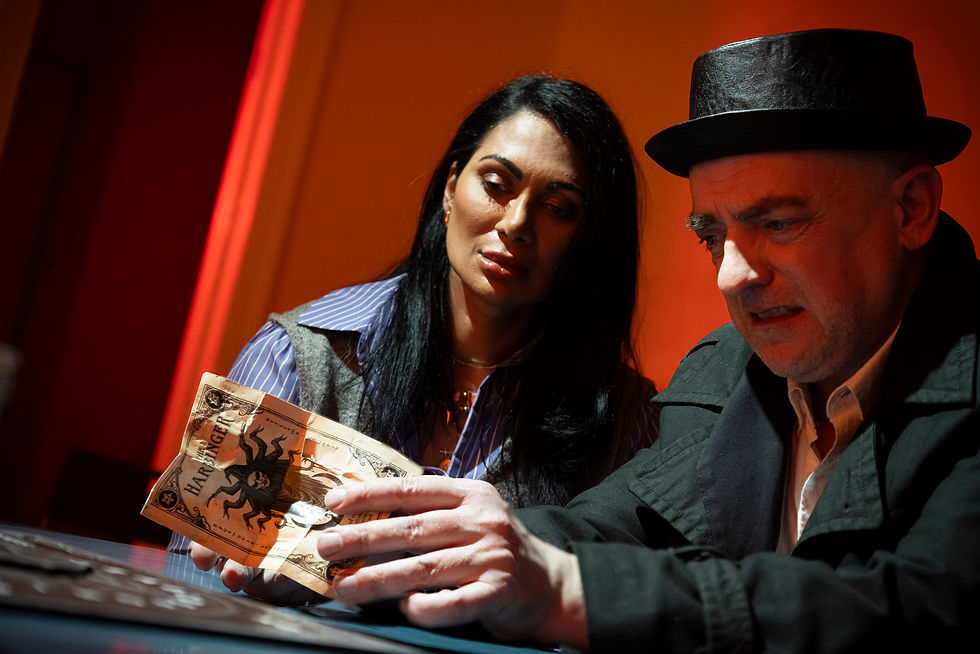
The rest of Harbinger's cast bring believability and freshness to each role, with a hint of over-the-top tongue-in-cheek which makes the characters fun. One noteworthy performance is Nick Nevern, who while never appearing directly in the film provides the voice of the Harbinger machine, giving it an oddly-accented quirkiness which belies the machine’s sinister predictions. The rest of the cast likewise brought their respective roles to life well. In particular, Tony Sands’ drama-focused TV psychic Neal, Johhny Palmiero’s family-focused occultist Chris, and Maisie Gee’s darker diva April stand out sharply when on the screen, and the dynamics between them and the rest of the cast is one of the most well-executed elements of the film. Harbinger’s cast’s professionalism and understated characterizations are among the best the author can recall in recent indie horror films.
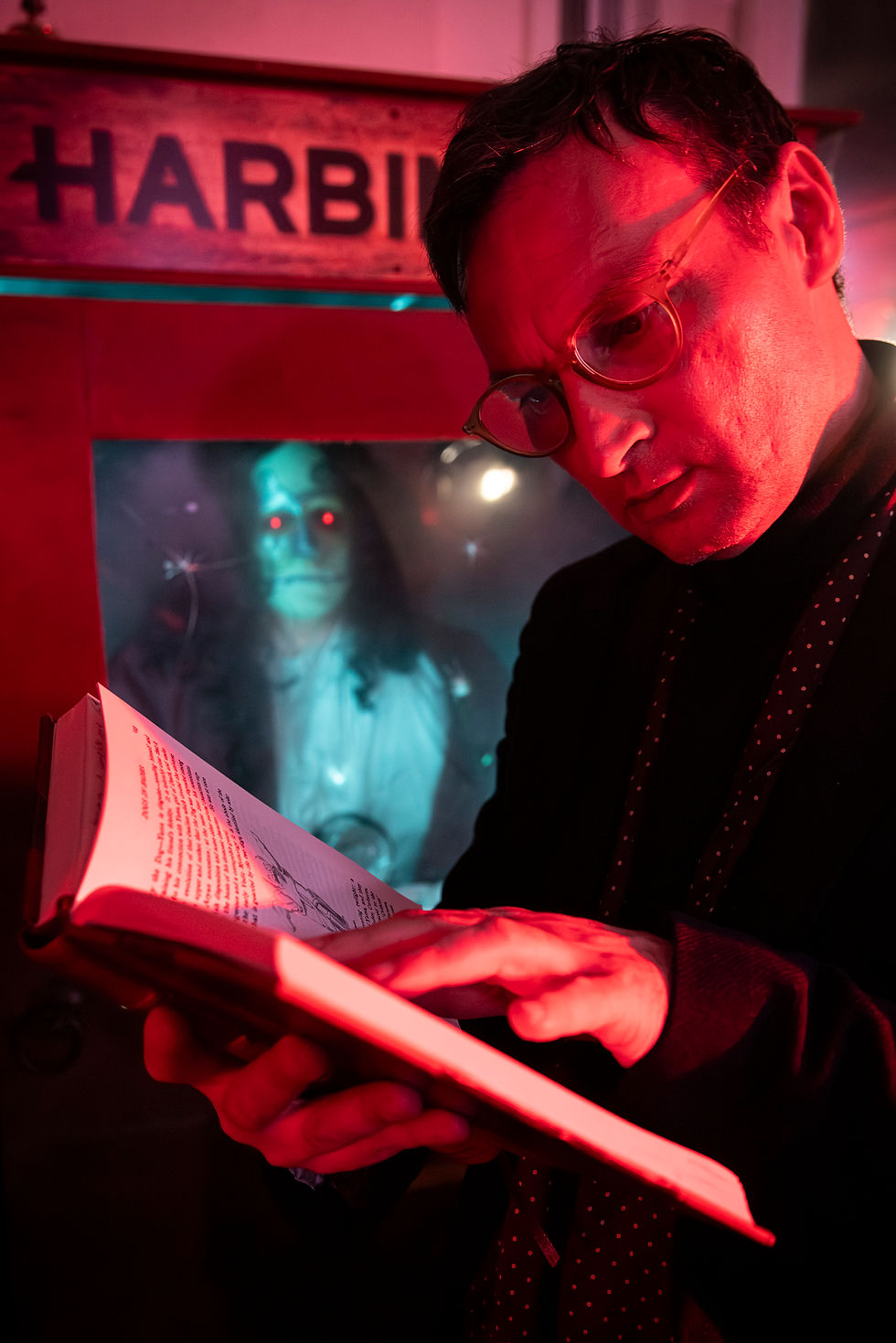
With the cast as a basis, the Hammer feel of Harbinger comes to life through the subtle details of the setting, wardrobe, and special effects. While the heart of the film is contained within one large house, it’s big enough that the film never feels cramped or constrained. While certain rooms appear more than others, the setting never seems stale, although some of the set dressing does feel a bit sparse at times. However, this in a way helps the ambience, as do the more subtle features such as the accessories and clothing of an individual character, pendants especially. The red and blue lighting during certain scenes, when combined with the white walls of the house, create a spooky, unnerving effect, adding shadows so the audience fills in the gaps, which adds an intimacy to certain scenes. Likewise, the practical effects are masterfully done and match the feel of the movie perfectly. They lack the bombast of Triple-A digital effects, but that provides the charm. A prime example is the Harbinger itself, designed and built by Stuart Webb, who also provided many of the special effects for the film. It’s never quite clear when the Harbinger is the animatronic box, or if they didn’t take an actual actor and slip him behind the glass. Arguably the strongest element working in the film’s favor is this subtle technical work.

Further understated, subtle satisfaction comes from Harbinger's story and writing, as while the dialogue occasionally comes across as wooden in the early stages, the film’s plot offers both woven complexity without overloading the viewer or leaving loose threads to snag at them. Harbinger is based on an idea by Johnathan Sothcott, Jeanine Nerissa Sotthcott’s husband and her fellow co-founder of Shogun Films, with a story written by Harry Boxley. Horror fans may know of Boxley’s work through his entries in the recent trend of taking public domain characters and turning them into slashers, ala Popeye’s Revenge, Mouseboat Massacre, and recently a string of fairy-tale princess themed ones. Harbinger’s screenplay was written by Simon Cluett.
Overall, the writing is solid and does what it sets out to do. Some of the dialogue never quite breaks into cult classic, so-bad-it’s-good campiness, but neither does the majority of it pain the ear, and necessary exposition is for the most part provided efficiently. Where the writing really grips you is the overall plotting, as subtle details return like a slasher with an axe buried in their skull for a surprising turn, yet by the ending, everything feels neatly tied together, and the ending left things finished perfectly. While the plot doesn’t hold anything horror fans haven’t seen before, its familiar fears frequently offer a satisfying surprise. The supernatural shares the focus with the slightly more mundane, but no less dramatic, subplots which bounce the characters off of each other in a way that makes you care for the characters all the more.
On a surface level, Harbinger offers exactly what Shogun Films, and Hammer Horror before it, sets out to provide: a high-quality fun flick with a mostly even Hammer Horror influence looming heavy. While it occasionally loses the atmosphere in places when things get bloody, the subtle nuances of the cast’s performance, the setting and special effects, and the best bits of the writing bring things together in a professional, experienced manner that makes the film well worth a second viewing. Harbinger does not throw its horror in your face but rather holds it at an intimate distance that leaves plenty of understated shadows which catch you by surprise, even when you know what’s coming.


Comments