


Who's Watching filmmaker Tim Kasher gives insight into his disturbing found footage horror film.

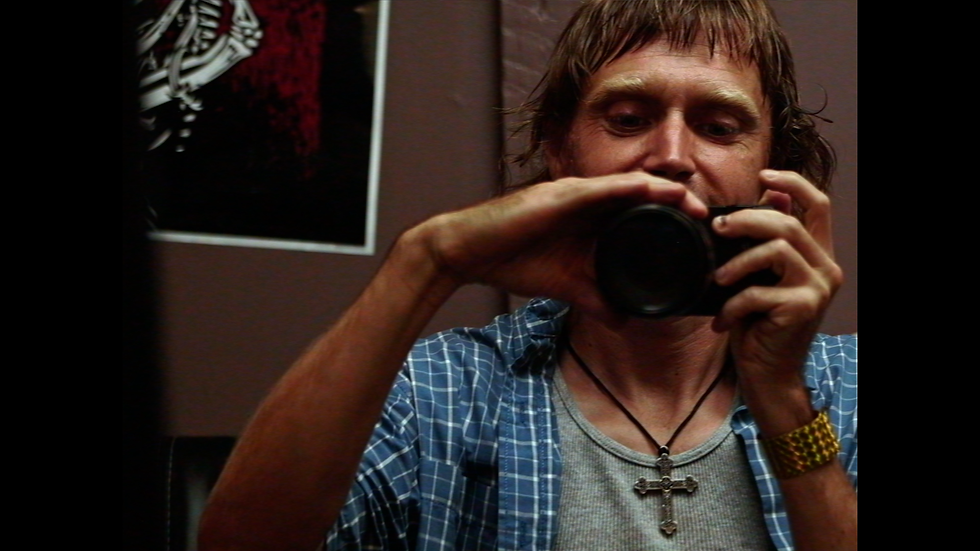
Dark Sky Films latest release, Who's Watching, follows a disturbed wannabe filmmaker named Caleb as he documents himself stalking his co-worker. The film is the feature debut of musician Tim Kasher, who wrote, directed and composed the film. We got to sit down and chat about some of the inspirations behind Who's Watching as well as Kasher's process in bringing his script to life.
This interview was edited for length and clarity.
The Horror Lounge: So to start, I know you're a musician. How did your work in that world influence your approach in filmmaking?
Tim Kasher: Oh, I don't know, I guess there's a lot of different approaches one could take to a question like that. One thing that has crossed my mind before, and this is pretty lofty, but having managed bands in the practice space, and managing them creatively, I should say, kind of gave me just enough confidence that I'm comfortable with working with others, and kind of politely, leading things. I think that those band environments have kind of shown that I don't really mind taking on a leadership role. And that's important. I mean, it certainly takes a certain type of person to run a show and to run a production like that. Who knows even if I'm, like, that capable with it? But I just feel comfortable enough. I feel comfortable enough with, in leadership roles, so I think that's… that's okay.
The Horror Lounge: Yeah, for sure. I mean, like you said, it takes that sort of skill to run a production and to direct people, and I feel like there's gonna be a lot of crossover between leading bands and managing creatively to creatively managing a film.
Tim Kasher: Yeah, and of course, it's a lot more moving parts with the film. But, there's also a lot more leaders delegated to all the different departments in film, too, so you're leaning on a lot of people, too, which is certainly helpful.
The Horror Lounge: Absolutely. Speaking of all the moving parts, what was kind of the day-to-day like on this set and shooting this?
Tim Kasher: I mean, pretty hectic, but not surprisingly...we had our days laid out pretty well, so I wasn't really pulling my hair out, necessarily, or anything like that. But, yeah, there's just so much, I feel like you don't have time to catch your breath, right? You're just always trying to fly to the next scene. The way I guess I see it is trying to pump the brakes just enough to make sure that the actors are comfortable, and and that you can get kind of the best performances out of them. I also don't want to freak out the crew too much either with, like, nervous energy. You know, always looking at the clock and stuff like that, trying to push people, push people along. I feel like that tends to not be very conducive to a good work environment and then you'll just end up with not as good of work. I think that it was a controlled chaos, you know?
The Horror Lounge: I feel like that could apply very well to the movie, "controlled chaos," based on the sort of cat and mouse game in the way the story is told. Speaking of the story, there's layers to this film, and especially in the third act, which kind of flips the story on its head a little bit. What was your process in writing that and kind of mapping out the story?
Tim Kasher: So there's been so many edits of this script, and, wild to mention, but the first draft I did of this was way back in 2010. I certainly have not been working on it for 16 years, but that was just the first time that the first draft was written. Then I picked it back up in 2018, that's when I picked up with Travis Stevens, great producer and director, and he was just really helpful. We started the back and forth of passing edits around, just trying to tighten up the script. Initially, the kind of… we'll just kind of loosely call it, like, Act 1 was the bulk of the film, and then we started expanding what we'll call Act 2. I try to avoid spoilers a little bit.
The Horror Lounge: Yeah.
Tim Kasher: It's a tricky movie to talk about, because it's kind of reveal-heavy, you know? So act 2 was something that I think started being expanded upon more with Travis and just trying to stretch the film into different realms, different ideas. Then what we'll call the third act section, that really came late. That was something that was a major revamping of the script that I did, I think in 2022. We shot this in 2023, and I think that's the most crucial and most compelling element of the whole film, where it leads to. I didn't come up with those ideas until really late into the editing process, and I find that, Interesting, but also, it's a good lesson for me, to just remember to just keep pushing until the ideas totally and finally feel, finished.
The Horror Lounge: Absolutely, it's very true what you said about the third act being such a big piece of the script. So it's funny that it came in later into the script's development, I think that's super interesting.
Tim Kasher: Yeah, and so for those that are familiar with the movie, it wouldn't surprise me in the least to have heard, some (other) filmmaker to say that that was where the whole idea started, because you can almost imagine that's where the whole idea started. It's kind of hard to talk about without just giving the whole thing away.
The Horror Lounge: So, what was the casting process like for this? Because there's some great performances.
Tim Kasher: Yeah, so Zachary Ray Sherman plays Caleb. He's just a totally incredible actor. I feel so fortunate to have him as a friend. We've known each other for 20 years now, which kind of blows our minds. We wanted to work together back in 2007, on a script I had way back then. And we couldn't get that into production but we've just stayed in touch all these years, kind of cheerleading each other on with the different projects that we've had, and so when I dusted off this script for Who's Watching I reached out to him just to see if it was a character that he'd be into doing, and he was really open to it. He takes on pretty challenging roles. He's just a really great actor, and I think he likes to take on those challenging roles, and so this was a pretty meaty one for him. He's just an incredible collaborator, too. I think Caleb is so fleshed out as a character... so much of that has to do with… with Zachary's work on it. Olivia Luccardi is just kind of a personal favorite actor of mine. I find her so compelling for her role in It Follows. But it wasn't until I saw her in a film called Soft and Quiet, I don't know if you caught… did you catch that film?
The Horror Lounge: I did not. I'll go watch that after this.
Tim Kasher: Incredible film, but it's really heavy. It's about, a small group of, female white supremacists up in the Pacific Northwest, and it's a kind of like a one-shot type concept, and it just gets really dark and messed up, but Olivia plays a pretty heinous individual. She plays one of the white supremacists in that movie, and her performance really blew me away, and so I looked her up, and we ended up meeting each other over Instagram. She was familiar with my music work, and so that helped a lot to be able to suggest to her that maybe I would send the script over to her, and she was really open-minded about it. And, you know, it all worked out. It was great. She's kind of my number one dream casting for this. Getting a chance to get one of your heroes, you know, like, actor heroes.
And Gracie Gillam, also is just totally incredible. One of our producers, Josh Ether, has worked with her in the past. She plays the role of Krista, and we were having a hard time casting Krista, because she's the one who's being stalked, and so she's mostly being objectified. Since a lot of the story is told through Caleb's perspective, it was hard to build her out as a character, because we were only able to show Caleb's impression of her, and he saw her mostly as an object. So that was tricky, but… I'll go back to Travis Stevens working and redoing rewrites with him. He really helped me build that character out some more, and I think we built it out enough that by the time we got to Gracie. the character of Krista was finally a more compelling and well-rounded character, and Gracie really responded to it. I was so glad, and we just really got along really well, so it was a great pairing.
The Horror Lounge: Oh yeah, Grace's performance in this is fantastic, and I really love what you said about, you know, the story being from Caleb's perspective, because I'm always super fascinated by stories that follow a very unlikable protagonist, you know? Stories where you're kind of stuck in the viewpoint of a villain. What were some of the challenges in fleshing that out in the script.
Tim Kasher: Well... I'll offer first some of the benefits of that. Something that Zachary and I really wanted to do with the Caleb character is manipulate the audience. I think that that's one of the powerful things about film, is that manipulation is a great tool, as long as you use it carefully, and don't overdo it. You don't want to, like, lose the trust of your audience. But we were able to do kind of light manipulation. So yeah, he's the main antagonist, but he's also the main person that we follow in this story. So much of this film is told through him, it's like he's actually the "filmmaker," who's making the movie. But since he's the "filmmaker," he's also the editor of his film. That means that he's always putting himself in a good light, in a better light. He's trying to make himself a cool guy. He's trying to present himself, in particular to Krista, who he's stalking. So, Zachary and I, we talked at length about how this goes back to the manipulation thing. How we wanted to bring enough empathy to the character to really kind of confuse the audience. So as far as the audience being able to recognize like, "geez, this guy's a skeevy guy, for sure, and it's terrible what he's doing," but… we also wanted to humanize him enough that, instead of just hating on him, the audience would hopefully find themselves troubled with themselves for, like, "why am I empathizing with this person? just wish this guy would do better," or "I wish he'd stop being such a pervert." I feel like we've really pulled that off. That's the response I'm getting from people, is them feeling conflicted about, like, "why am I feeling empathy for this awful person?"
By the end of the movie, I think the empathy's all gone. Or it should be, that's the point. But we had fun developing that and creating that and getting to that point where you know he's a bad person, but you just wish he wasn't. So that was a benefit, I think for us. The way I see it is being kind of hamstrung, like, we have our hands tied behind our back when you're making Caleb's movie, because it has to be from his perspective, and it might not always be the perspective that we want to tell, and then that kind of goes back to that kind of subtle manipulation.
The Horror Lounge: Yeah, we're seeing what he wants us to see, right?
Tim Kasher: Exactly.
The Horror Lounge: What you said about, kind of feeling sorry and almost empathizing with him, I really felt that a lot in the first act. Because at the beginning of the story, without spoilers, Caleb starts off as just kind of a guy who seems very socially awkward. He doesn't really have any friends at his job. He's taking care of his grandmother, and I'm like, "Okay... this guy's weird, but, you know, we'll see." Then, like you said, by the third act, it's like, all that goodwill has been totally drained.
Tim Kasher: Yeah, it really does.
The Horror Lounge: With everything that ensues in this movie... there were multiple moments where I was like, "he's not doing this."
Tim Kasher: Yeah, and that's kind of the reaction that we're hoping to get from the audience. Just kind of like, "geez, man, would you please stop doing this?"
The Horror Lounge: I'm also really fascinated by the blend of found footage and traditional cinematography. So, I'm curious, was that always the plan going in, or was there maybe a version of this that at one point would have been entirely found footage? Because I think that's such an interesting concept. I see it in a few other movies from time to time, and I think it's a neat concept for telling a story.
Tim Kasher: Yeah, that's the original kernel of this story way back in 2010, and I'll say this vaguely, because it is kind of reveal heavy. But, that idea of blending found footage with omniscient storytelling. So, that's where I started with the ideas. I just thought that was interesting, to do something that blended found footage with an actual film a bit more, and in ways that I hadn't seen done prior. So that was the original thought, and then from there I needed to plug ideas into that kind of more technical film trickery that I was excited about, and that's when I realized that a classic stalker script would fit that really well. And you also get to then work with really core human ideas of just, wanting... but also objectification and sexualization. So then you also are getting to tackle social issues about what can be wrong about being raised under a patriarchal society, and misogyny that kind of just runs rampant in young men, or, you know, men, I guess we should say. Not just young.
The Horror Lounge: I think a lot of those social issues definitely come through in the script, especially commentary on incel culture, and I believe that word is mentioned in the film, and there's even a moment where Caleb says, "I'm a nice guy." So yeah, I definitely think those social issues shine through in the script there.
Tim Kasher: Yeah, interestingly this was just brought up in a Q&A the other day. That, since the first draft was in 2010, that was a good handful of years before incel was even a term that we were using. The incel concept has always been around but writing that into the script was absolutely a later rewrite, because I wouldn't even have known that word in 2010.
The Horror Lounge: What were some film inspirations behind Who's Watching?
Tim Kasher: So, a big one as far as a big influence is a deep dive I did into Michael Haneke, a few years back. The Austrian filmmaker who did, I think most notably Funny Games, but, you know, did a lot of great movies, Hidden Cash and The Piano Teacher, Benny's Video. But his stuff, it's so bleak, it's so heavy, but it also tends to be such an indictment on humanity. I just really like his approach; it's not for everyone. As far as just how he'll get under your skin with his storytelling. Discomfort, that's what I think when I think about Michael Haneke. So, yeah, that was an influence for me, for sure. Then maybe more on the surface is things like Michael Powell's Peeping Tom from 1960. I mean, I think that movie's really fascinating, and I was certainly influenced by that idea. Another one that just as far as the aesthetic of the film that kind of excites me is River's Edge. I don't know if you're familiar with that movie, but it has a young Keanu Reeves in it and Dennis Hopper's in it. It's about a bunch of metalhead kids running around a small town. There's a dead body involved, and it's pretty macabre. The aesthetic and tone of that was something that I thought about a lot, too.
The Horror Lounge: I always love asking directors things like that, because then I walk away with a whole new list of movies to go watch.
Tim Kasher: I want to look up and just see who the director is, because I do like mentioning River's Edge... yeah, it's 1986, Crispin Glover is also in it. Of course, he's incredible in it. It's directed by Tim Hunter.
The Horror Lounge: I'll have to go on a letterbox deep dive after this. I'm also really glad you mentioned Peeping Tom, because I put in my notes, that this was like a very gritty, modern approach to Peeping Tom. The way (Caleb) always had the camera, it was almost like the camera was his eyes, he really wasn't doing anything without it. That influence shined through a lot, and as a fan of Peeping Tom, I think it's super underrated, and it's really unfortunate that, as much as I love Psycho... Psycho kind of overshadowed it. Same year, similar kind of concepts. So super glad to hear that shout-out.
Tim Kasher: The story about Peeping Tom and Psycho coming out the same year, that's heavy, it's heavy stuff. Just how Psycho just became the biggest movie ever, and Peeping Tom ruined Powell's career. It was crazy.
The Horror Lounge: That's such a bummer, because both were kind of the founding fathers of slashers, these were one of the first big studio films to be like, "What if the monster was just another guy?".
Tim Kasher: Yeah.
The Horror Lounge: I think you hit the nail on the head earlier, discomfort. This one really got under my skin, and is very visceral ways in a lot of parts, and again, Zachary, just kills it in this role.
Tim Kasher: Yeah, he's my hero, he's incredible.
The Horror Lounge: It's funny, you mentioned earlier about collaborating with him, you were the composer on My Suicide, and he had a small role in that.
Tim Kasher: Yeah, that's good sleuthing, my friend. That's when we first met. So, the director of My Suicide, David Lee Miller, he was aware that I was writing my own scripts as well, and I had a script back then. So, David wanted us to meet, because Zachary's role in My Suicide is pretty small. It's a smaller side story, but David was just like, "This young man is an absolutely incredible actor, you need to get to know him". And so, he linked us up. We've been trying to work together ever since, so this was our first time really getting to pull it off.
The Horror Lounge: I will say, I did love all the little music video sequences. I already knew by the press notes that you were a musician, and I could tell. It has that flair.
Tim Kasher: Yeah, it was a blast. Getting to write the metal songs was just so much fun. I'm a metal fan, but I don't write metal myself. I think it's just not in my lane, you know? It's always just something I appreciate everyone else doing, you know? But, yeah, it was a blast.
Who's Watching will be available digitally and in select theaters on September 18, and the film's soundtrack will be available on October 30th, 2026. You can read our review of the film here.
For more horror news, commentary, and reviews, be sure to follow The Horror Lounge on Facebook, Twitter/X (@TheHorrorLounge), Instagram (@the.horror.lounge) and Bluesky (@TheHorrorLounge).
If you enjoyed this interview, be sure to follow me on my socials such as my Twitter/X (@JacobAtTheMovie), Facebook (TheJacobHarper), Instagram (@JacobTheHarper) and Letterboxd (@JacobTheHarper).


Comments