


The director (Cregger’s) cut: Is Resident Evil a survival horror film?
Resident Evil fans are amongst the most avid- some would say ravenous- devourers of horror, especially of entries in the franchise which coined the term “Survival Horror.” Whether feasting on the nine main courses or sampling the side dishes, which range from spin-off games to novels, CGI films, and even but live action movies have always been a bit of an acquired taste. Ever since Mia Jovovich awoke in the mysterious mansion in the 2002 Resident Evil, some fans found the divergence from the original canon not to their taste. Others went back happily for seconds and thirds, but by the time they had fourths, fifths, and so on, the Paul W. S. Anderson-directed series had become a little stale, and some RE fans developed a deep-rooted stomachache anytime the idea of a new adaptation came along, especially after the under-done Welcome to Raccoon City. But from its announcement in 2025, Zach Cregger’s take, also titled Resident Evil, promised a new flavor of viral horror. If anyone could make Resident Evil feel fresh without losing the flavor of RE, Cregger seemed the one to do it.

Cregger stated that for his “love letter to the series,” he wanted to tell his own story in the setting, and as production began and wrapped and teasing tidbits and appetizers were brought to light, speculation on how closely the Weapons director would stick to the lore and feel of the games varied, and Cregger suggested he was striking out into new territory. While visual shout-outs abounded in the trailers, Cregger also stated that zombies, practically the poster child of the series and a staple of its gameplay, wouldn’t be as vital as they were in the Anderson series, although he would bring in plenty of the lethally-mutated menaces players have been surviving for thirty years. So the question in many fans minds becomes how closely Resident Evil follows the style of the gameplay, as while many film adaptations capture elements of the classic style, Survival Horror doesn’t always lend itself to film.
The tense loop of Survival Horror is a deep and murky ocean often confused for a lake, but to give a brief run-down of the basics of Survival Horror, players find themselves controlling often-hapless heroes trapped in deadly dungeon-like locations, usually sinister mansions, zombie-infested cities, and occasionally outer space. Exploring these locations, players scrounge for scarce supplies such as ammunition and healing items while contending with creatures who lurk behind every corner and inside every vent. Were that not enough, players must also solve mystifying puzzles and locate the items needed to progress to new, often deadlier areas, occasionally gaining new weapons to keep them alive against ever-deadlier monsters. Backtracking is frequent and routes often vary. Survival horror forces the player to make decisions, from forcing them to choose between vital health and ammo, and enough space for unexpected windfalls, and often avoiding a fight can be key to surviving. Eliminating an enemy means backtracking becomes safer, but if the player uses up vital supplies, they risk being under-prepared later in another area.

The RE series created this gameplay loop, but it didn’t stick to it in later entries. Ironically, the action-packed Anderson films led to 2005’s Resident Evil 4 had a more 3rd-person shooter element, with stunning enemies in order to deliver flashy melee attacks and the addition of Quick-Time-Events (cinematic sequences where players need to input the correct button-press in a short period of time) which became staples of the series for some time. RE eventually leaned too heavily into this more action-packed style, which divided fans and forced Capcom to rethink its approach, leading to a refocusing on the gristly horror which built the series, although recent entries still have a good bit of action for those of us fans who enjoy the chainsaws and boomsticks approach in games.
So with thirty years of games to pull from, how does Cregger’s entry compare?
Spoilers ahead! If you’d rather spare yourself the spoilers, then feel free to try our spoiler-free review.

So, to put it bluntly, Cregger’s Resident Evil doesn’t feel like an RE adaptation so much as an “RE spritz” -a faint hint of that sweet, mutating RE flavor, but so sparing and diluted that it almost might as well be water. While we see obvious and at times intriguing symptoms of Survival Horror gameplay and RE themes throughout the movie, the references are minor, and there’s some major divergences which almost leave the viewer feeling like they’re watching a lackluster Twitch streamer or YouTube Let’s Player thrown into an RE clone. Ironically, we see something of a progression through the movie which matches the game play development of the Resident Evil franchise, which is a point in its favor, but the change happens swiftly.
In the early stages of the movie, as Bryan is flung into the murky mysteries, we see the closest match to the original Survival Horror formula. Bryan finds items he has to use creatively to handle obstacles, such as avoiding and trapping a creature instead of spending his finite ammo killing it, although the point becomes a bit moot. There’s an emphasis on the limited ammo, as Bryan frequently counts his ammunition and tries to mind his Bs and Cs (bullets and clips.) He must, as the creatures he encounters are frequently dangerous and hard to kill, and sometimes killing them just leads to a bigger problem down the line. In both the remake of the original game and the most recent entry, Resident Evil: Requiem, killing enemies but leaving the heads intact means they will rise later as tougher, more aggressive and coordinated foes. The film uses this for its nastier nemesis which pursues Bryan throughout.
For the first half of the film, escape requires exploration, whether that’s searching the house for ammo for a newly acquired shotgun (the box of which is one of the sparing shoutouts to the games) or facing a locked gate with a diamond-marked padlock. Searching his environment for solutions and supplies is a vital Survival horror skill, and the opportunities for it abound in the movie’s scenario. At one point later in the film, Bryan even uses a convenient map to find his next destination. It sounds very basic, but anyone who has fought through Raccoon City or Silent Hill will recall looking at their map and debating on if they should go the direct route, or double back into another room to look for that one healing herb that they didn’t have inventory space for.
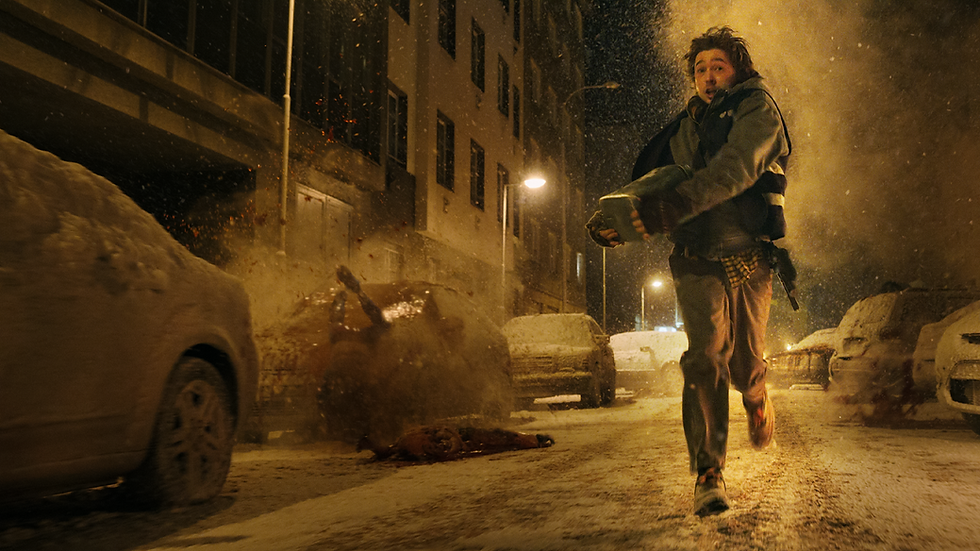
In the latter half of the film, however, the break-neck speed of the film somewhat falls into the action-packed style of the latter entries in the series, although not necessarily in the good way. Bryan finds himself running from one unnerving monster to the next, but never really dealing with any of them, even when he expends ammunition to do so. He even survives a harrowing action sequence in a dissolving elevator and gets hands-on with a particularly gross infected. He doesn’t have the flair of Leon S. Kennedy, but the scene feels like it would have fit into one of the earlier adaptations. However, this is where the connection with the gameplay drops, removing one of the few connections with the franchise the film gets its name from, and the lack of connection is where the film falls flattest.
Aside from a few names, the film’s connections to the franchise are minimal at best, and the story and themes don’t feel like Resident Evil. Although the acting is well done from all cast members, and the technical elements from CGI to sound design are strong. But having a dog’s head split open to reveal a lamprey-like mouth and tentacles is not enough to call a film and RE adaptation, no matter how many easter eggs you hide within. The fast pace prevents the introspection and growing dread which a Survival Horror game can bring, and often the payoff is brutally fast, a jump scare that is forgotten within five minutes, and perhaps the payoff is comical a little too often. However, where Resident Evil (2026) falls hardest is with its characters and themes.

Let’s start with the main focus of the film, our hapless “hero,” Bryan. Austin Abrams does a terrific job of bringing the character to life and making him perhaps too realistic and unlikeable, and he doesn’t embody many traits even the more antiheroic characters of Resident Evil bring to make them memorable. We see Bryan as a weak-willed, reactionary individual who is incompetent well past the point of comedy. He shoves off problems onto others, deflects and dissembles anytime he does something he knows is wrong even when he is arguably justified (his monologuing as he leaves the RV after perhaps the darkest scene in the film is a prime example.) and while he does seem to have a realization and internal development, it falls flat as the film rushes past it.
Throughout the RE games, the heroes (and often the villains) do adapt and change over time, even when they are blatantly scoundrels. Luis Serra from RE 4 is a prime example, a former Umbrella researcher who seeks redemption for having a hand in creating the biological monstrosities, viral weapons, and parasites which afflict the world of Resident Evil. The remake humanizes him further, turning him into a would-be Don Quixote, but even in the original, Luis was a slick charmer, scummy but not in a way that made him difficult to dislike. Welcome to Raccoon City honestly did a better job of having a comedic slacker of a protagonist with Avan Jogia’s Leon Kennedy. Breaking with the suave, noble characterization of Leon, Jogia brought an in-over-his-head, not remotely prepared vibe to Leon, which is one of the few highlights in the film. While Constantin Films’ last attempt at an adaptation was lackluster, it at least clung unabashedly to its source material, bringing the camp and an attempt at the charm, and it engages with the themes which are lacking in Resident Evil (2026).

RE has always been a campy tale of survival amidst tragedy, with hapless heroes struggling to survive against unlikely odds and the evils of ruthless researchers who lack a basic understanding of safe laboratory practices and corporate executives willing to put money and their own, often insane, goals above their fellow man. While Bryan is an everyman and a stand-in for the viewer, he’s hardly the person any gamer would hope to be in such a scenario. At least most gamers would try not to waste ammo on locks constantly, and he’s not fighting to survive for a noble cause, to avenge those lost to corporate greed or to save as many as he can. Honestly, the author was left wondering as to his goals frequently. While it is likely impossible to know how one would react to such a scenario until one is in it, the RE franchise argues that, training or not, even an architect like Ethan Winters of RE 7 and RE Village can fight against the horrors.
To bring back the Don Quixote elements of Luis Serra, it is likely dreaming an impossible dream to ask that a movie based on a video game capture the feel perfectly. But Resident Evil (2026), while high quality in many aspects, barely feels like it deserves its title. Its special effects are easily as cutting edge as the effects of the Anderson series. The sound and lighting and cinematography are well-tuned, and the acting by the cast is stellar. But the film falls into the plague which we often see with sequels, reboots, and adaptations in recent years; it borrows the name of a popular franchise but doesn’t really engage with any of the elements or lore which built the franchise.
Aside from a few proper nouns and creature design elements, Cregger’s “love letter to the series” could have been written to any Survival Horror game. Bryan delving into an urban hellscape filled with unnatural, Lovecraftian monsters as he wrestles with his personal demons could have made Resident Evil (2026) a return to Silent Hill. A troubled courier struggling with fatherhood while unknowingly carrying the key to curing a devastating virus could be The Last of Us. The film had everything going for it, from a rising star if a director to clearly talented and fun actors and special effects which make for a creepy time. Viewers will have to decide for themselves if it’s an enjoyable movie, but this author asserts that the search for a good Resident Evil adaptation continues.

Comments